
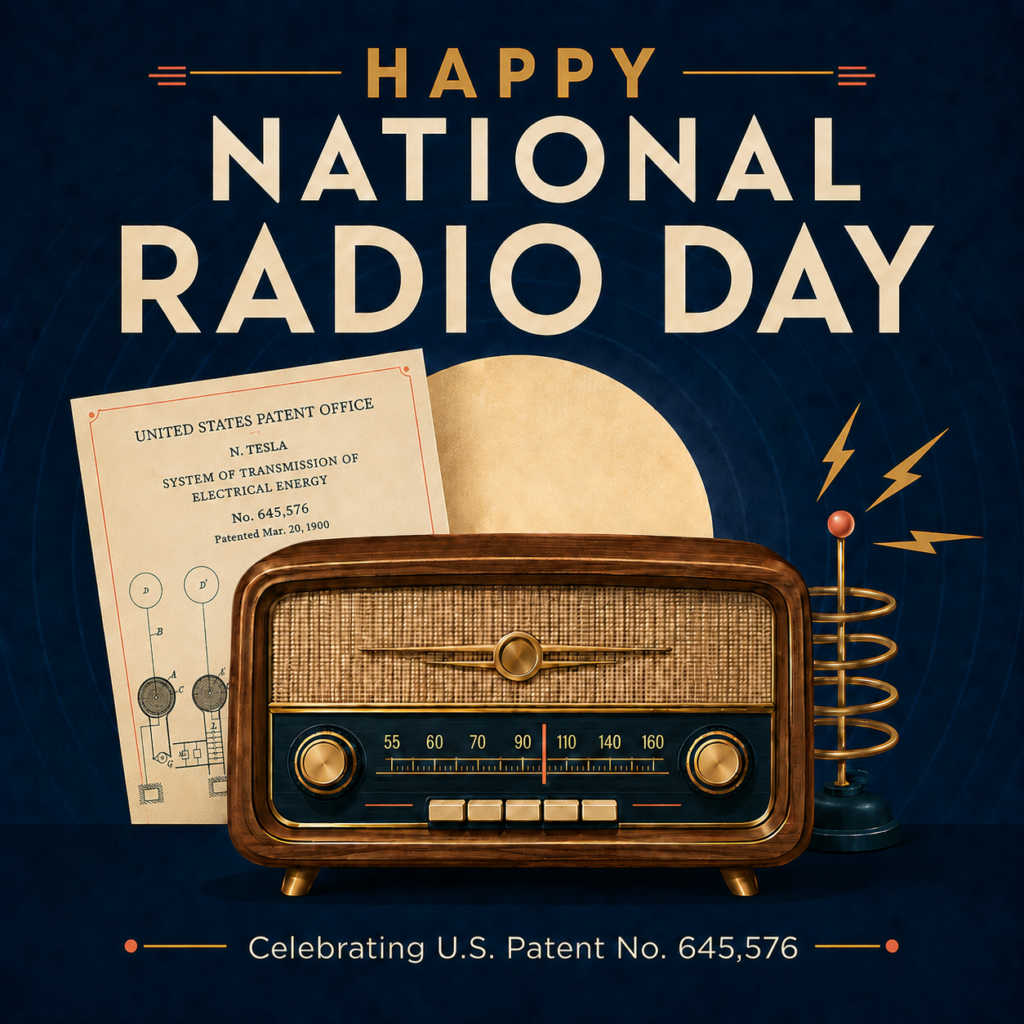
 Today, we can listen to music, news, sports, and entertainment with the simple push of a button. However, the technology behind radio began with experiments conducted more than a century ago—and patents played an essential role in documenting and protecting those discoveries.
One particularly important example is Nikola Tesla’s U.S. Patent No. 645,576, titled System of Transmission of Electrical Energy.
An Important Step Toward Wireless Communication
Tesla filed the patent application on September 2, 1897, and the patent was granted on March 20, 1900. It described a system for transmitting electrical energy without connecting the transmitting and receiving devices with wires.
The system used two electrical circuits tuned to work together. A transmitter generated high-frequency electrical signals, while a receiving circuit detected those signals from a distance. This concept of tuned—or resonant—circuits would become an important part of radio communication.
In simpler terms, Tesla was working on a way to send electrical signals through the air and have a specific receiver respond to them.
Why Tuning Was So Important
Imagine several radio stations broadcasting at the same time. Without a way to tune a receiver, all of the signals could interfere with one another.
Tesla’s system demonstrated how transmitting and receiving circuits could be adjusted to the same frequency. This helped establish the concept of selecting a particular signal while reducing interference from others.
That same basic principle is used whenever someone tunes a radio to a specific station.
Radio Was Not the Work of One Inventor
The invention of radio cannot be credited to just one person or one patent. Scientists and inventors—including James Clerk Maxwell, Heinrich Hertz, Nikola Tesla, Guglielmo Marconi, and others—made important contributions to the development of wireless communication.
Tesla’s work focused heavily on high-frequency electricity, resonance, tuned circuits, and the wireless transmission of signals and energy. Marconi later developed and commercialized practical wireless telegraph systems, helping bring radio communication into widespread use.
Together, these discoveries transformed radio from a scientific experiment into a technology capable of communicating across cities, oceans, and eventually the world.
The Lasting Impact of U.S. Patent No. 645,576
Tesla’s patent did not describe a modern AM/FM radio exactly as we know it today. Instead, it protected foundational technology that helped make reliable wireless transmission and reception possible.
The principles behind the invention contributed to the continued development of:
- Radio broadcasting
- Wireless telegraphy
- Remote-control systems
- Television transmission
- Cellular communication
- Modern wireless devices
What began as a complicated arrangement of coils, circuits, and electrical oscillations helped pave the way for a world in which information can travel instantly without wires.
Patents Preserve the Story of Innovation
U.S. Patent No. 645,576 is more than a historical technical document. It provides a detailed record of Tesla’s work and shows how one patented idea can influence generations of future technology.
Patents preserve the drawings, descriptions, and claims behind inventions that have changed everyday life. Displaying an important patent recognizes the inventor’s achievement while celebrating the creativity and determination required to turn an idea into something meaningful.
At US Patent Services, we transform issued patents into professionally crafted patent plaques, reproductions, and awards. Whether you are recognizing a historic invention or celebrating your company’s newest patent, we can help create a lasting display honoring the innovation behind it.